System Architecture
Overview
CloudAEye self-hosted Code Review supports Amazon ECS only. The Terraform bundle deploys CloudAEye on ECS Managed Instances in a customer AWS account, with public access through an Application Load Balancer. The UI, APIs, authentication service, and MCP service are public ALB targets; workers and data services remain private inside the Amazon VPC.
Service Flow Diagram
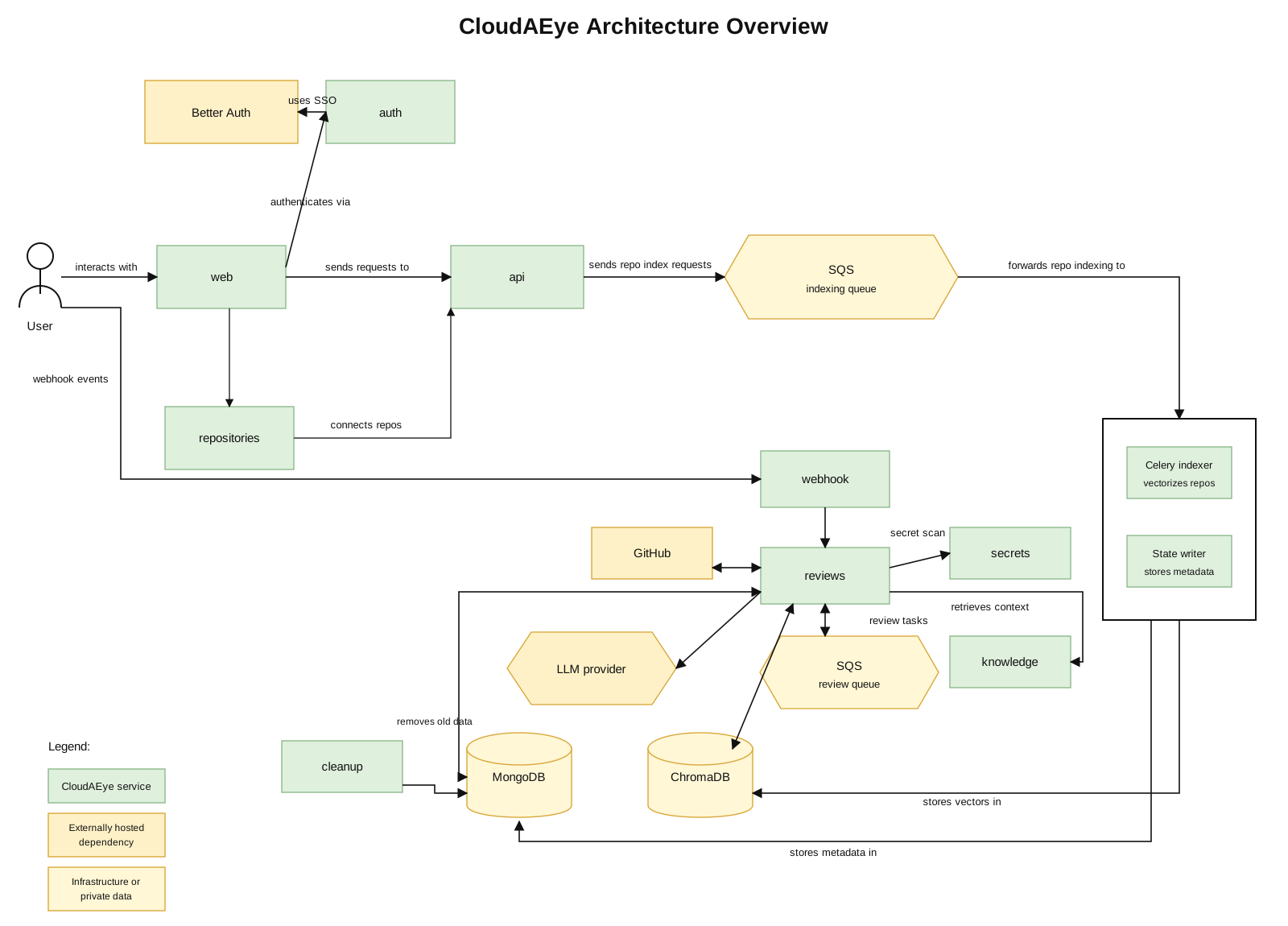
AWS ECS Deployment
| Layer | AWS resources | Purpose |
|---|---|---|
| Entry point | Application Load Balancer | Public HTTP or HTTPS listener and path-based routing for the UI, APIs, auth, MCP, SSO, and GitHub webhooks |
| Runtime | ECS cluster with ECS Managed Instances | Runs CloudAEye application containers, workers, MongoDB, ChromaDB |
| Network | VPC, public subnet, private subnet, internet gateway, NAT gateway | Keeps ECS tasks private while allowing public ALB ingress |
| Service discovery | AWS Cloud Map private DNS | Provides internal names for mongodb.cloudaeye.local and chromadb.cloudaeye.local |
| Queue | Amazon SQS | Separate cloudaeye-indexing-queue and cloudaeye-review-queue for asynchronous work |
| Authentication | Better Auth | Handles tenant login and SSO integration through the cloudaeye-auth service |
| Storage | EBS volumes | Persists MongoDB data and ChromaDB vector data |
| Observability | CloudWatch log groups and ECS Container Insights | Stores service logs and cluster/task metrics |
Core Services
| Service | Exposure | Function |
|---|---|---|
cloudaeye-web |
Public | Serves the CloudAEye web console |
cloudaeye-auth |
Public | Handles login, tenant registration, and Better Auth flows |
cloudaeye-mcp |
Public | Provides MCP commands like /cloudaeye:review |
cloudaeye-api |
Public | Lists tenant repositories and supports UI API requests |
cloudaeye-repositories |
Public | Connects repositories and starts repository provisioning |
cloudaeye-indexer-api |
Public | Starts vectorization and sends indexing work to SQS |
cloudaeye-webhook |
Public | Receives GitHub webhook events and starts pull request review work |
cloudaeye-reviews |
Public | Orchestrates pull request reviews and review queue processing |
cloudaeye-secrets |
Public | Scans pull request changes for secrets during review processing |
cloudaeye-knowledge |
Public | Serves the knowledge graph at /knowledge-graph |
Background Workers
| Worker | Runtime | Function |
|---|---|---|
cloudaeye-indexer-worker |
ECS background task | Consumes cloudaeye-indexing-queue, vectorizes repositories, and writes artifacts to ChromaDB and MongoDB |
cloudaeye-reviews |
ECS background task | Consumes cloudaeye-review-queue, reads artifacts from ChromaDB and MongoDB, calls the LLM provider, and stores review results in MongoDB |
cloudaeye-cleanup |
Scheduled ECS task | Runs once per day and removes old data from MongoDB |
Infrastructure Services
| Service | Function |
|---|---|
| MongoDB | Private ECS service with encrypted EBS storage for application data, tenant state, review results, and license status |
| ChromaDB | Private ECS service with encrypted EBS storage for vectorized code artifacts |
| Amazon SQS | Provides cloudaeye-indexing-queue for indexing work and cloudaeye-review-queue for review work |
| Better Auth | Provides authentication and SSO-backed login for cloudaeye-auth |
| AWS Cloud Map | Provides private DNS names for MongoDB and ChromaDB inside the VPC |
| Application Load Balancer | Public entry point for the web console, APIs, SSO callbacks, and GitHub webhooks |
| CloudWatch Logs | Stores ECS service logs and cluster/task metrics |
Setup Flow
This flow covers login, repository selection, provisioning, and vectorization.
- The user opens the CloudAEye UI at
/uithrough the public ALB. - The UI sends login and tenant requests to
cloudaeye-auth. cloudaeye-authuses Better Auth for authentication and SSO-backed login.- After login, the UI calls
cloudaeye-apito list repositories available to the tenant. - The user selects a repository in the UI.
- The UI calls
cloudaeye-repositoriesfor repository integration and infrastructure provisioning. - The integration service calls
cloudaeye-indexer-apito start vectorization. cloudaeye-indexer-apienqueues vectorization work incloudaeye-indexing-queue.cloudaeye-indexer-workerconsumes indexing jobs, generates vector data, writes code context to ChromaDB, and records processing state in MongoDB.
MCP OAuth
The cloudaeye-mcp service exposes /mcp resource and uses cloudaeye-auth for OAuth.
Pull Request Review Flow
This flow covers GitHub webhook processing and review generation.
- GitHub sends webhook events to the
cloudaeye-webhookservice. cloudaeye-webhookforwards the pull request event tocloudaeye-reviews.- During review, the
cloudaeye-reviewsECS service callscloudaeye-secretsto scan the pull request changes for secrets. cloudaeye-reviewssends asynchronous review work tocloudaeye-review-queue.cloudaeye-reviewscallscloudaeye-knowledgeto retrieve knowledge graph context.- Review processing uses ChromaDB and MongoDB to retrieve repository context created during vectorization.
cloudaeye-reviewscalls the configured LLM provider to generate review output.- Review state, review results, and related application data are persisted in MongoDB.
Networking And Security Boundaries
The ALB is the only public ingress path. Its security group allows inbound traffic on the configured application port from allowed_app_cidr.
All ECS tasks run in the private subnet with assignPublicIp disabled. Private tasks use the NAT gateway for outbound access to ECR, AWS APIs, source control providers, license validation, and configured LLM providers.
MongoDB and ChromaDB are reachable only from ECS tasks through the ECS service security group and Cloud Map private DNS. They are not registered behind the public ALB.
Runtime secrets and customer-specific values are supplied through Terraform variables and container environment variables. Protect terraform.tfvars and Terraform state because they contain sensitive values.
Storage
MongoDB and ChromaDB each run as a single ECS service with an encrypted EBS volume. MongoDB stores application data, tenant state, and review results. ChromaDB stores vectorized code context used during review generation.